Choose a CNC chessboard's square size around the actual pieces, then multiply that dimension by eight to find the playing field. Add the border separately, and compare the complete blank and holding arrangement with the machine's available space. The grid alone is not the size of the woodworking project.
The controlling measurement is the piece's footprint, not its height alone. A tall, slender king and a shorter piece with a broad base can need different spacing. Shrinking a board file does not shrink the pieces already bought to use with it.
Start with the pieces on the squares
Inspect the actual set before committing to a square size. Measure the bases of the broadest pieces, check the pawns, and notice any projections beyond the bases. Do not assume that the king is necessarily the widest piece, or that two sets described by the same king height have identical footprints.
Draw or print a full-size grid and place several pieces on neighboring occupied squares. A piece centered on an empty square answers only part of the question. Players also need to distinguish neighboring squares, reach between adjacent pieces, and lift and replace them without an unnecessarily crowded arrangement. Check a populated part of the board rather than judging one attractive piece on an otherwise empty drawing.
This paper layout is a design check, not a machining trial or certification. It can reveal an awkward relationship between the proposed squares and the intended set before material is cut. If you are also carving the matching chess pieces, settle their intended base dimensions alongside the board layout. If the set already exists, treat those dimensions as fixed while exploring the board size.
Use tournament dimensions in their proper context
FIDE's equipment rules effective from March 1, 2026 specify equal squares measuring 5–6 cm per side, with four pawns fitting comfortably on one square. These are tournament-equipment benchmarks; they do not require every home board to have those dimensions.
A separate FIDE proportion puts a piece's base diameter at 40–50% of its total height. That denominator is the piece's own height, not the width of a square. It cannot be used as a square-sizing formula. A base-to-square preference found in a shop's size guide is a different relationship again.
For a home project, compare the actual set with the intended layout. For an event board, check all applicable equipment and event requirements. Meeting one square-size criterion does not make a homemade board FIDE-approved.
Calculate the playing field before the border
There are eight squares along each side. Multiply the chosen square width by eight to obtain the width of the playing field. Then add the border on both sides to obtain the outside board dimension. A coordinate band or personalized inscription needs its own allocated space; it should not silently reduce the playable squares.
Consider a hypothetical CNC Christmas project intended to accompany an existing chess set. If 50 mm squares suit that set, the playing field is 8 × 50 = 400 mm across. A 25 mm border on each side makes the outside board 450 mm across. If the pieces instead need 55 mm squares, the field becomes 440 mm and the same border produces a 490 mm outside board.
| Illustrative dimension | 50 mm squares | 55 mm squares |
|---|---|---|
| Playing field | 400 × 400 mm | 440 × 440 mm |
| Border on each side | 25 mm | 25 mm |
| Outside board | 450 × 450 mm | 490 × 490 mm |
These are design calculations, not recommended dimensions or a tested pattern. The 5 mm change to each square accumulates to 40 mm across the field. With the border unchanged, the outside board also grows by 40 mm in each direction. A modest adjustment for the pieces can therefore change the required blank and machine substantially.
The reverse decision has consequences too. Reducing the border preserves the square-to-piece relationship but leaves less room for coordinates or decoration. Reducing the squares changes that relationship. If a smaller overall board is essential, return to the occupied paper layout rather than assuming that either change is harmless.
Keep the playing surface readable and usable
FIDE's Laws of Chess describe an 8 × 8 grid of equal, alternating light and dark squares, with a light square at the near-right corner from the player's position. Establish that orientation before adding labels or directional decoration.
The current equipment guidance also calls for light–dark contrast and a non-reflective face. Those qualities help explain why the surface matters alongside its measurements; a wood species or finish name alone does not establish compliance.
A CNC chessboard does not require a groove or pocket at every square boundary. Its construction and appearance need to distinguish the squares while leaving an appropriate standing surface for the pieces. For example, a raised decorative ridge crossing a square could prevent a broad base from sitting as intended, even if the top-view render looks orderly. Examine the surface the pieces actually occupy, not only the artwork around them.
Compare the whole board with the CNC envelope
The hypothetical 50 mm-square design already has a 400 × 400 mm field and a 450 × 450 mm outside board. The physical blank may be larger still. Holding hardware, accessible cutter travel and holder clearance also affect the setup when evaluating a CNC router for woodworking.
The TwoTrees TTC6050 CNC router lists a nominal working area of 600 × 500 × 100 mm. Compare that specification with the complete job. It does not by itself establish that either illustrative board, its stock and its holding arrangement will fit.
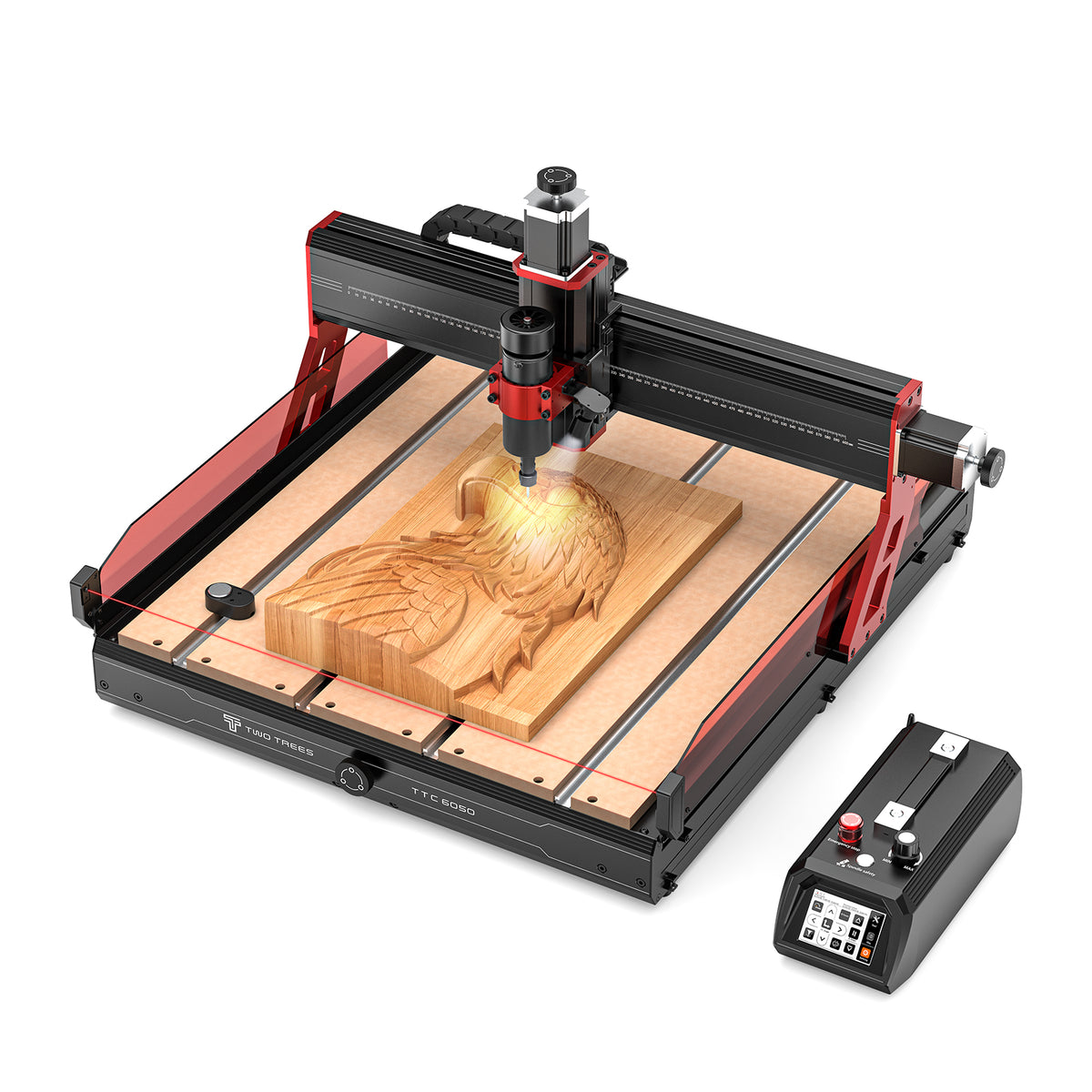
The 490 mm-wide alternative makes the distinction particularly clear. Although 490 is numerically below 500, that comparison says nothing about excess stock, where holding hardware sits, or whether the tool and holder can reach the whole planned feature without interference. A dimension smaller than advertised travel is a starting comparison, not a completed setup assessment.
The machine's outside dimensions answer another question: whether the equipment fits the workshop. They are not the machining area. Keep physical footprint, nominal travel and the usable assembled setup separate when comparing a board drawing with a machine diagram.
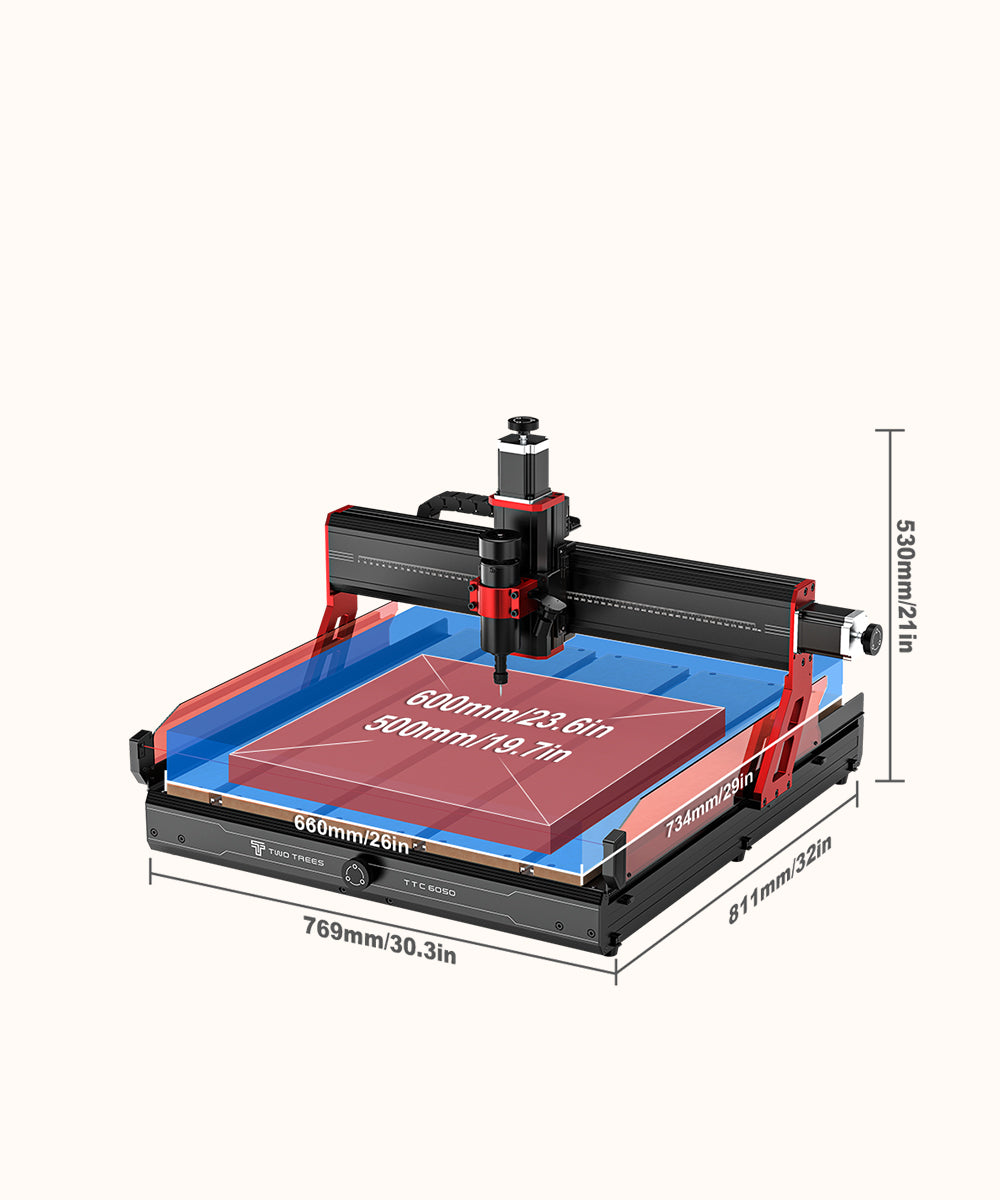
If the complete design does not fit, reconsider the machine, the piece set or the project dimensions deliberately. Do not shrink the artwork while retaining the same large pieces, and do not assume that an oversized board can be machined by repositioning it without a separately planned process.
Paper fit does not qualify a toolpath or manufacturing method. Follow the equipment's directions for suitable material and tools, secure holding, guarding and dust control. Stop and isolate the machine as directed before hands-on inspection.
Before preparing toolpaths, make the design explicit: which pieces were checked, the square width that suits them, the eight-square field, the border and the complete blank. Those linked dimensions let you change one part of the project while understanding what else must change with it.