The TwoTrees ED1 aluminum vise bench clamp can be a good fit for small, rigid blanks when they have dependable grip surfaces, can be supported without interfering with the cutter, and leave enough clearance for the tool and machine motion. Large flexible sheets, thin fragile parts, irregular unsupported shapes, and parts whose perimeter must be cut may be better served by a well-designed flat-bed fixture.
Start With Part Shape and Cutter Access
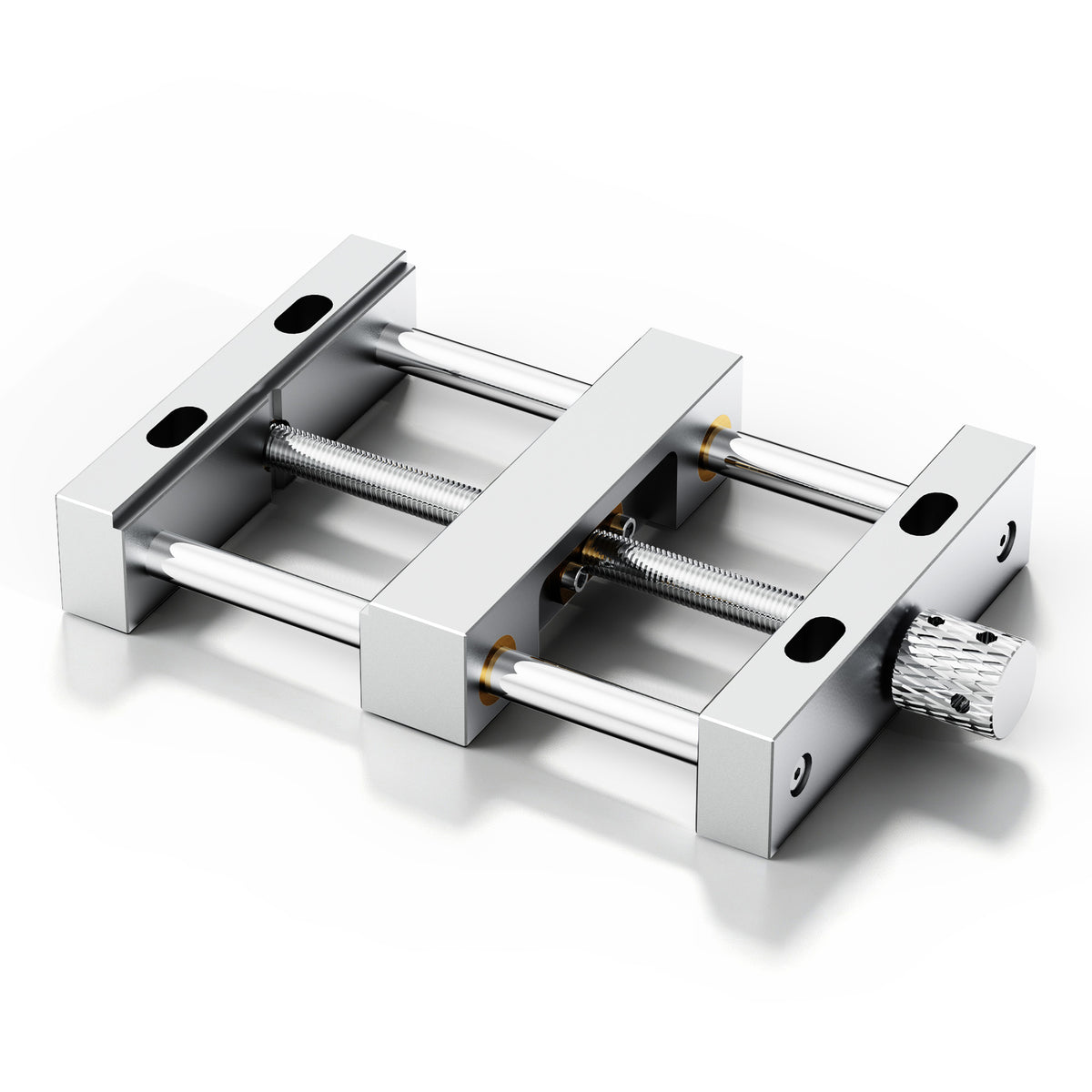
A vise makes sense when the part’s shape allows it to be gripped without blocking the work. A small aluminum prototype base or a compact hardwood stamp block can suit this arrangement: the vise grips the sides, the top face remains available for machining, and the cutter can reach the intended features.
A wide flat decorative panel is a different case. Its size, flexibility, and need to machine across much of its surface can make side-grip workholding less suitable. A flat-bed setup may distribute support across the sheet and leave the cutting area open, whereas jaws can obstruct perimeter features or create unsupported spans.
The ED1 desktop CNC’s 300 × 200 × 120 mm work area describes the platform’s work area, not the usable volume inside a vise. The vise, stock, cutter, tool holder, and required cutter path must all fit together with adequate clearance.
Follow the Cutting Force Through the Setup
Cutter force travels through the stock, into the jaws, through the mounted vise, and into the machine table. A vise works best when that path is short, stable, and well supported. A compact rigid blank gripped close to the cutting area gives the force a direct path; a tall or protruding workpiece can act like a lever and deflect under load.
That is why part height and support matter as much as material. A small rigid block held close to the jaws has less opportunity to move than a tall blank extending far above them. If the portion being cut is unsupported or far from the grip, even a secure vise cannot make the setup inherently stable.
Consider Grip Allowance and Final Release

A vise needs material to grip. If the finished part requires cutting around its entire perimeter, the jaws may occupy space the cutter needs to reach. In that situation, a vise can still be useful for an intermediate operation, but a different fixture may be better for the final pass that releases the part.
Plan the sequence around both the cutting access and the moment the part becomes free. A compact hardwood stamp block, for example, may be held by its sides while its top features are machined, then released after the job. A part whose outline must be cut completely free may need a fixture strategy that supports the stock without placing jaws in the cutter’s path.
Plan how the part remains supported at the end of each operation, and follow the machine’s stop and isolation procedure before releasing or repositioning stock. Good side grip cannot substitute for a stable final-release strategy.
Locating and Clamping Are Different Jobs
Clamping keeps the part from moving; locating establishes where it is relative to the programmed coordinate system. A vise can provide repeatable physical positioning for similarly prepared blanks, but it does not by itself establish the work origin.
For jobs where the programmed origin must match an edge or center on the actual blank, a compatible workpiece probe can help locate that reference. The TwoTrees ED1 3D wired probe is identified for locating edges and centers and supporting origin positioning. It complements the vise’s holding role; it does not secure the stock.
Repeat parts can benefit from consistent blank preparation and a consistent reference, but no workholding setup guarantees precision by itself. Chips beneath the stock, variable blank dimensions, worn or damaged reference surfaces, and changes in seating can all alter how a part sits in the vise.
Match the Vise to the Project
Hypothetical example: a maker machining a small aluminum prototype base with features on its top face may find the vise useful. The blank is rigid, its sides provide grip surfaces, and the top remains accessible for the cutter. The force path is compact, and the perimeter does not need to be cut free during the same operation.
By contrast, a maker machining a wide, thin decorative panel with a detailed border may prefer a flat-bed setup. The panel needs broad support, the border may extend close to the stock edges, and side jaws could interfere with the cutter or leave unsupported material.
The ED1 aluminum vise is therefore a project-driven accessory, not an automatic addition to every job. It fits when the blank is suitably rigid, the grip surfaces are reliable, the cutting area remains accessible, and the vise-and-stock arrangement leaves adequate clearance within the TwoTrees ED1 CNC router machine work area.
Does the aluminum vise work only with aluminum parts?
No. “Aluminum” describes the vise’s construction material, not a restriction that it can hold only aluminum workpieces. Suitability depends on the blank’s rigidity, grip surfaces, support, cutter access, and the exact machining operation.