A fourth-axis CNC can machine some features that are inaccessible from a single fixed orientation, but rotation does not make every undercut reachable. The deciding question is whether the actual cutting tool can approach, remove the required material and withdraw while its neck, shank and holder remain clear. A smaller blank or an additional rotary axis does not answer that question by itself.
For a small decorative part, this distinction can determine whether the rotary accessory adds useful access or whether the design needs a different approach. An exposed recess brought toward the cutter is one problem. A recess still sheltered by a lip is another. Both may appear in the same model, yet require different machining decisions.
An Undercut Is Relative to the Tool's Approach
Harvey Performance describes an undercut as a feature in which one portion of the workpiece overhangs another. That overhang matters because material the design requires you to keep can obstruct the tool's route to material you need to remove. “Undercut” is therefore more informative than simply calling a feature deep or internal.
A deep, open recess can have a clear approach, subject to suitable tooling and the actual machine arrangement. A much shallower recess can be difficult when a projecting lip prevents a standard tool from entering or reaching its back surface. Depth and outside size alone do not distinguish those cases. You need to consider the surrounding geometry and the tool's direction together.
It also matters which part of the cutter can do the work. A tip that can touch one point does not show that the cutting edges can generate the entire required surface. Nor does a visible gap around the cutting end establish room for the larger shank or holder above it. Access concerns the assembly moving along a path, not a single contact shown in a CAD view.
What Rotating the Part Changes—and What It Leaves Behind
Consider a hypothetical small wooden decorative component held along a horizontal rotary axis beneath a fixed-direction spindle. One side carries an open recess. Another area has a recessed detail beneath a projecting lip. This is a design example, not a machining test or a claim that a particular ED1 setup can produce the piece.
Rotating the component can bring the open recess toward the cutter. A feature that was on the far side of the blank may then have a usable approach. That is the practical benefit of angular presentation: the same secure holding arrangement can present different regions of the part for an appropriate machining strategy.
The lip, however, rotates with the rest of the component. At any proposed cutting position, you must still ask whether it blocks the chosen tool. A new angle might resolve the obstruction, or it might merely make the hidden detail easier to see on screen while leaving the shank or holder unable to follow. Visibility and machinability are not equivalent.
In this conventional fixed-spindle, single-rotary arrangement, rotation about one axis does not provide arbitrary tool tilt. It also does not automatically supply an approach along the part's end. Exact machine kinematics and the feature's direction govern; the word “fourth axis” is not a substitute for examining those relationships.
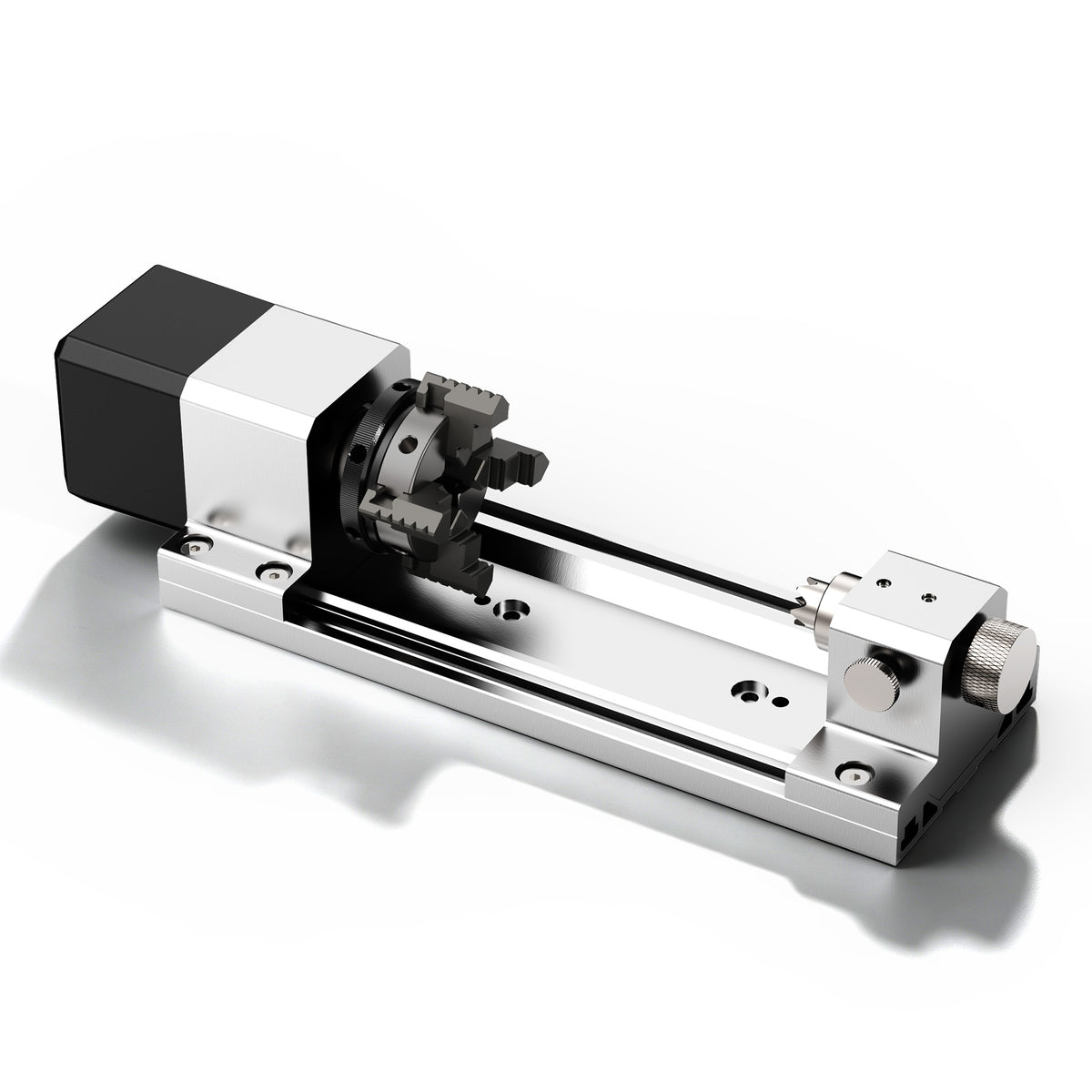
This is where the ED1 fourth-axis CNC rotary module kit has a concrete role. It is the dedicated rotary accessory for projects that benefit from presenting a supported part at different angular positions. Start with a feature that needs that access, then evaluate the holding and tool arrangement that would make it useful.
Specialized Tool Geometry Can Change the Answer
It would be equally misleading to conclude that every undercut is impossible. Harvey's undercutting-tool guidance explains how a spherical cutting end and reduced neck can provide clearance that a standard tool lacks. These cutters are often called lollipop cutters. Their geometry can allow a cutting edge to reach behind certain overhangs while the narrower neck clears surrounding material.
That is not the same as simply choosing an ordinary ball-nose cutter. A rounded tip describes only part of the geometry; the neck and the usable cutting region determine what can be reached beside or behind it. A tapered ball-nose tool selected for general carving should not be assumed to offer the same access as a purpose-designed undercutting tool.
The clearance comes with a tradeoff. Harvey notes that thinner necks can increase clearance while reducing rigidity. The relevant choice therefore includes the actual feature, tool geometry, permitted projection, holder and operation—not just whether the cutting end looks small enough. A longer tool may change reach without removing the obstruction, and extending a cutter farther is not a universal remedy.
Return to the hypothetical sheltered recess. If a suitable specialty cutter could enter through the available opening, reach the required surface and leave safely, the feature might have a viable tooling route. If the opening prevents entry or the holder cannot follow the required movement, changing the cutting end alone has not resolved the problem. This is an application decision for the exact tooling and machine, not a blanket recommendation that a particular undercutter fits the ED1.
A Blank That Fits Is Not Necessarily a Feature You Can Cut
The ED1 desktop CNC router presents rotary applications that include cylinders, curved objects and multi-sided carving. Those are useful project directions, but each design still contains individual surfaces that need a workable approach. The complete part should be evaluated feature by feature rather than approved from its overall silhouette.

Clamping bounds help answer whether the proposed stock can be accommodated. They do not describe every possible cutting direction inside that stock. The wooden component could fit between the holding regions yet retain a lip that blocks the required tool. Making the whole component smaller would not necessarily remove that relationship; it could also reduce the opening available for the cutter.
Likewise, a CAM path displayed on the target surface is only part of the machining plan. The tool assembly, remaining stock and fixture must be represented accurately enough to evaluate access throughout entry, cutting and withdrawal. A simulation cannot account for hardware omitted from the model, and a finer stepover or additional passes cannot remove a physical obstruction in material that must remain.
Resolve the Hidden Feature Without Losing Its Purpose
When rotation alone does not provide access, reconsider the feature's purpose before committing to a workaround. If the lip is purely decorative, opening or moving it may preserve the intended appearance while exposing the recessed surface. If it retains, locates or protects something, removing it changes the function and may not be an acceptable design revision.
A different orientation or operation sequence is another possibility, but it must preserve a secure hold and a meaningful reference for the remaining work. A feature exposed in a new position is not useful if that position removes the material needed for gripping or conceals the reference required to locate the cut. Changing the sequence solves the problem only when the later operation remains supportable and accessible.
Where the hidden geometry is essential, appropriate specialty tooling or a different manufacturing route may be necessary. Autodesk's rotary CAM reference illustrates that tool direction changes pocket-wall geometry and that some orientations can require additional axis capability. This supports evaluating the necessary approach, not assuming that a five-axis machine automatically reaches every enclosed or sheltered surface.
Before running any program, the exact machine and tooling instructions, secure workholding and complete assembly clearances must be satisfied. Stop and isolate the machine as directed before hands-on setup; do not gain access by loosening the work or using unsupported tool projection. For the decorative component, the design is ready to progress only when both the exposed recess and the sheltered detail have a viable route—not merely because the blank can rotate.