A ball nose end mill has a hemispherical cutting end. A bull nose end mill, also called a corner-radius end mill, keeps a flat central end with rounded corners. Choose between them from the surface you need: a continuously curved face, a flat floor with a rounded wall-floor transition, or a flat-bottomed feature better suited to a plain flat end mill.
Neither name means “the best finishing cutter.” The useful comparison is the shape each tool brings into contact with the workpiece. Once that matches the intended feature, material suitability, entry capability, reach and holding still need separate checks.
A rounded tip is not the same as rounded corners
Look at a side section through the cutter. The conventional ball nose is rounded across its end; a bull nose has a flat region between its radiused lower corners. A plain flat end mill supplies a third reference: a flat end without the deliberately specified corner radius of a bull nose. Autodesk’s milling-tool introduction distinguishes these forms and relates their selection to the geometry being machined.
The distinction matters when shopping for CNC router bits. “Spiral” describes the flutes, not whether the cutting end is flat, hemispherical or partly flat with radiused corners. Two spiral cutters can therefore produce different bottom profiles. Read the end-profile drawing and the specified dimensions rather than treating similar product names as equivalent.

One wooden panel can need different end forms
Consider a hypothetical decorative wooden panel with a flat recessed border surrounding a curved carved emblem. The border is intended to look level, while the emblem has a gently domed face and flowing details. This is a design example, not a reported machining test.
For the border, first decide what the junction between the floor and the wall should look like. If the drawing calls for a flat floor without a deliberate rounded bottom blend, an appropriate plain flat end mill is the reference choice. If the drawing specifies a rounded transition there, a suitable bull nose may address the flat region and that blend together. CIMCO identifies a bottom wall fillet as an application for a bull-nose end mill.
That is not permission to add a radius wherever a softer edge seems attractive. Imagine that the panel’s recessed border must accept a separate decorative insert. Changing its bottom transition could prevent the insert from seating as intended. Conversely, removing a specified blend could change a visible design detail. In either case, the requirement comes from the part, not from whichever cutter happens to be available.
For the curved emblem, evaluate a ball nose against the actual model. The relevant question is whether its rounded end can address the changing surface angles and the tool can reach the necessary regions. The choice does not automatically resolve a narrow valley, an inaccessible recess or a holder collision.
The TwoTrees ball nose end mill is a concrete example when choosing CNC router bits for wood: its current listing describes a solid-carbide, two-flute tool with a 3.175 mm shank for shallow wooden bas-relief and curved wood surfaces. Those are manufacturer-listed applications, not a guarantee that it will complete every feature on this hypothetical panel.
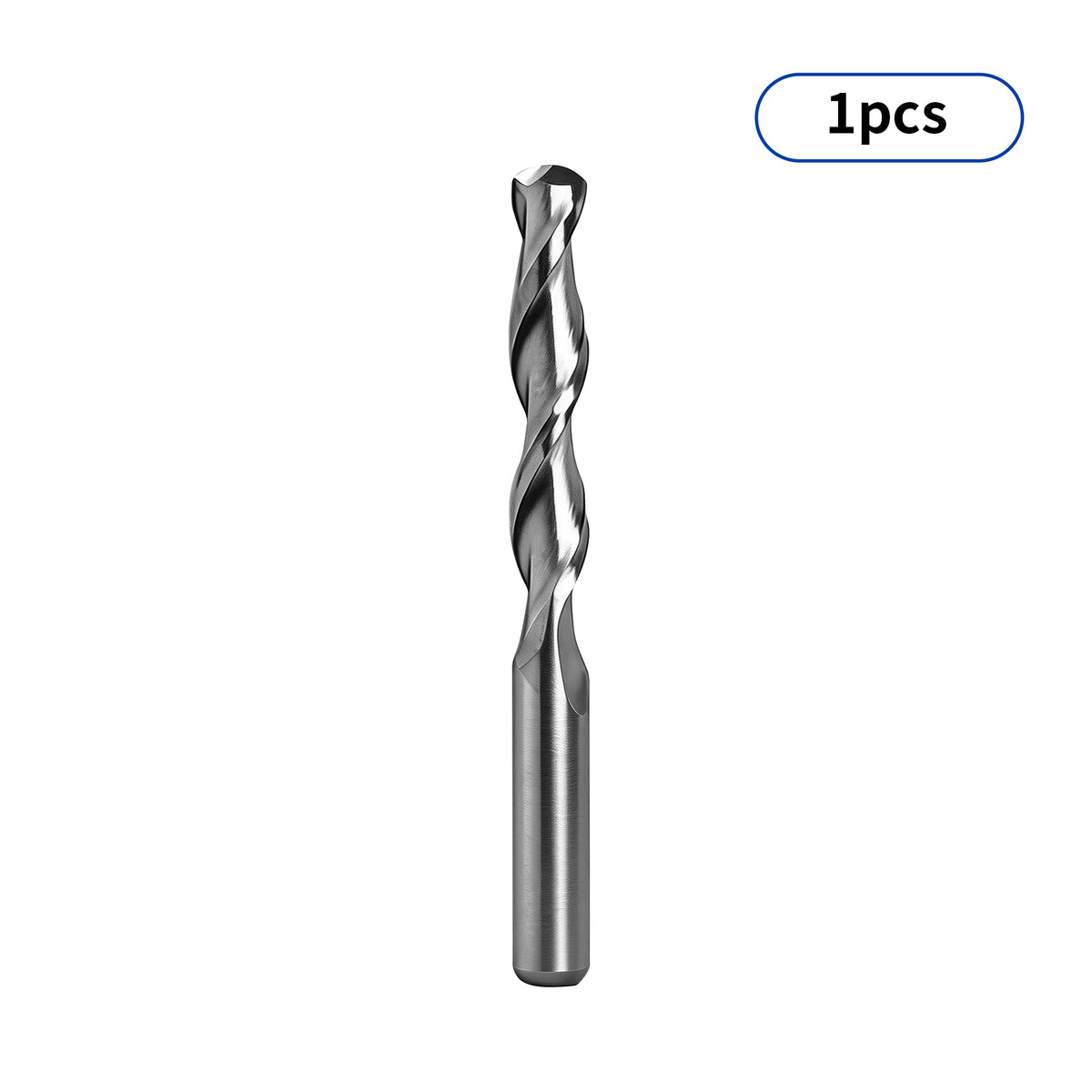
TwoTrees’ separate flat-ended wood-cutting end mill provides the plain-flat reference. It is not a bull nose merely because it is another spiral cutter. Keep those identities separate when comparing a product image with a tool description.
Check the corner in two different views
The word “radius” can refer to two different boundaries on the same recessed border. Viewed from above, the rotating cutter’s circular cross-section limits the inside corner it can reach. Viewed in side section, the wall-floor junction depends on the cutter’s lower-edge form. UNSW’s tooling module distinguishes the internal corner associated with a round cutter from the additional bottom fillet left by a ball or bull nose.
For the wooden panel, the border might need rounded corners in plan view but no deliberately rounded bottom blend. Another design could require both. These are different requirements even though the drawing may label each with a radius.
A smaller corner radius on a bull nose does not, by itself, tighten a plan-view corner if the cutter’s overall diameter stays the same. Likewise, choosing a smaller overall diameter does not establish the bottom blend you want. Compare both dimensions with the intended feature. This avoids buying a cutter that appears to match one radius while changing the other.
Closer ball-nose passes do not change the tool’s shape
Adjacent ball-nose paths can leave geometric peaks called cusps or scallops. Reducing the spacing between passes reduces those peaks, but it does not turn the hemispherical end into a flat one. Autodesk explains this distinction when comparing flat surfaces with curved surfaces.
On the hypothetical panel, closer passes may make sense for the sculpted emblem. Applying the same approach across the entire flat border, however, can mean adding passes to compensate for a tool form that is not the most direct match for that region. A flat area does not become a curved-surface task simply because both belong to one part.
Nor is a smaller geometric cusp a promise of a finished wood surface. Grain, the cutting edge, toolpath and setup still affect the result. Separate the questions: first choose a form suited to the feature, then plan the operation and assess its surface. There is no universal spacing value that settles both decisions.
End shape does not authorize the entry move
Ball, bull and flat identify nose geometry. They do not establish whether the cutter is center-cutting, which materials it supports or which entry moves its manufacturer permits. CIMCO treats center-cutting capability as a separate property. Do not infer permission for a straight plunge—or for every ramp—from the word “ball” or “bull.”
The same separation applies to fit. A matching shank size alone does not establish usable cutting reach, holder clearance or the suitability of the selected cutter for the material. Confirm those requirements against the exact tool and machine instructions. Secure the workpiece, follow the machine’s guarding and dust-control requirements, and stop and isolate it as directed before tool changes or hands-on inspection.
Return to the panel’s drawing to resolve the choice: a ball nose is the form to evaluate for the curved emblem; a plain flat tool may suit the flat recessed border; a bull nose becomes relevant where that border specifically needs a matching rounded wall-floor blend. The chosen end form answers the shape question. The exact tool’s material, entry, reach and holding limits determine whether it can perform the planned operation.