


CNC Router Bits
Choose TwoTrees CNC router bits and end mills for carving, lettering, pocketing, profiling and 3D finishing. Compare V-bits, spiral cutters, ball-nose tools, T-slot cutters and bit sets by shank size, flute geometry, material compatibility and CNC spindle fit.
-


Twotrees 40 PCS End Mills CNC Router Bits
Regular price €89,95Regular price -


Twotrees Solid Carbide 60° V-Bit
Regular price €14,95Regular price -


Twotrees Solid Carbide 90° V-Bit Set 4PCS
Regular price €26,95Regular price -


Twotrees 15 pcs Milling Cutter Set for Wood Router
Regular price €31,95Regular price -


Twotrees Solid Carbide Round Bottom Bit
Regular price €17,95Regular price -


Twotrees Solid Carbide 2 Flute Spiral Ball Nose End Mill Set
Regular price From €17,95Regular price -


Twotrees Solid Carbide 2 Flute Spiral End Mill Set
Regular price From €17,95Regular price -


Twotrees Solid Carbide 2 Flute Straight End Mill
Regular price €17,95Regular price -
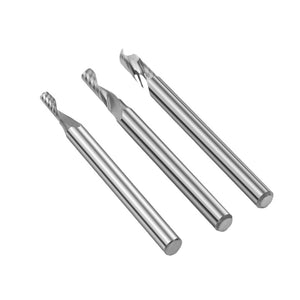
Twotrees 3 PCS | HRC55 Carbide | 3.175mm End Mills Cutter
Regular price €31,95Regular price -


Twotrees Solid Carbide 3 Flute Spiral End Mill Set 5PCS
Regular price €62,95Regular price -


Twotrees 4 Flute T-slot milling cutter
Regular price €35,95Regular price -


Twotrees 3 Flute T-slot milling cutter
Regular price €13,95Regular price -


Twotrees TiN Coated High Speed Steel Twist Drill Set 50PCS
Regular price €17,95Regular price -


Twotrees TiN Coated Solid Carbide Corn End Mill Set 10PCS
Regular price €26,95Regular price -


Twotrees Nano Blue Coated Solid Carbide Corn End Mill Set 10PCS
Regular price €26,95Regular price -


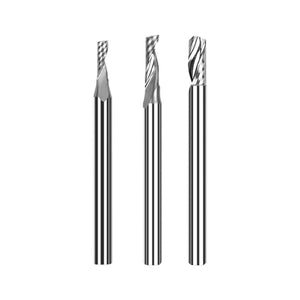
Twotrees Solid Carbide Single Flute Spiral End Mill Set 2PCS
Regular price €26,95Regular price
Know More
How to Choose CNC Router Bits and End Mills
The right CNC router bit depends on the cut, material, machine and tool-holding system—not simply the largest set. This collection brings together CNC end mills, V-bits, ball-nose cutters, single-flute tools, T-slot cutters and mixed sets for carving, profiling, pocketing, lettering and detailed milling. Check every product page for its exact shank size, cutting diameter, flute length, material guidance and operating limits before ordering.
If you need the machine rather than the cutting tool, browse CNC routers. For collets, motors and other machine components, use the CNC router accessories collection. Keeping those categories separate makes it easier to compare tools without mixing them with machines or general accessories.
1. Match the Cutter Geometry to the Job
| Tool type | Typical task | Material guidance | Check before ordering |
|---|---|---|---|
| V-bit | V-carving, lettering, signs, chamfers and decorative grooves | Commonly selected for wood and MDF; use on other materials only when the product specifies them | Included angle, tip size, shank diameter and required engraving depth |
| Flat or spiral end mill | Profiles, pockets, slots and general material removal | Choose flute geometry and cutting conditions for the specific wood, plastic, composite or non-ferrous material | Cutting diameter, flute direction, flute count, cutting length and shank size |
| Ball-nose or tapered ball-nose end mill | 3D contours, relief carving, finishing and curved surfaces | Useful for compatible wood, foam and other machinable materials listed for the tool | Tip radius, taper angle, reach, step-over and total tool clearance |
| Single-flute end mill | Chip evacuation in acrylic, plastics and selected soft materials | Can provide more chip space, but still needs suitable speed, feed and cooling conditions | Tool diameter, flute length, chip evacuation and the product's material limits |
| Corn-tooth cutter | Routing compatible PCB, carbon-fiber sheet and composite materials | Use only where the product specifies the material and provide effective dust control | Cut quality, cutter diameter, dust extraction and suitable PPE |
| T-slot cutter | Undercuts and T-slots after a suitable starter path has been machined | Use only with adequate machine rigidity, workholding and tool clearance | Head width, neck diameter, shank size, cutting depth and entry path |
2. Check the Shank, Collet and Spindle
A bit must fit the installed collet exactly. Two products in the same collection can use different shank diameters: for example, the 40-piece CNC bit set uses a 3.175 mm (1/8-inch) shank, while the 15-piece wood router bit set uses a 6.35 mm (1/4-inch) shank. An ER11 designation describes a collet system, not one universal bit size. Verify the installed collet, its clamping range, the spindle's permitted tool size and the available clearance.
3. Select the Bit for the Material
Wood, MDF and plywood are often machined with straight or spiral end mills for pockets and profiles, V-bits for lettering, and ball-nose tools for relief work. Acrylic and other plastics usually benefit from a cutter and settings that evacuate chips before they melt or recut. PCB and carbon-fiber work requires a tool intended for the material plus proper dust extraction and personal protection.
Cutting aluminum or another non-ferrous metal requires more than a carbide label. Confirm that the exact cutter, CNC platform and spindle setup support the material, then use secure workholding, shallow test cuts and conservative parameters. These desktop cutting tools should not be assumed suitable for steel or for industrial metal-removal workloads.
4. Use Flute Count, Feed and Speed Together
Flute count changes chip space and the relationship between spindle speed and feed rate. More flutes are not automatically better: if chips cannot escape, heat, melting, burning and premature tool wear can follow. Start with guidance for the exact tool and material, calculate a conservative chip load, make a shallow test cut and adjust one variable at a time while monitoring sound, chips and finish.
5. Check Cutting Length, Reach and Runout
Choose the shortest tool that safely reaches the programmed depth. Excessive stick-out reduces rigidity and can increase chatter or breakage. Before machining, clean the shank and collet, insert the tool to a safe clamping depth without bottoming it out, tighten it correctly and confirm that the nut, tool and spindle can clear the stock, clamps and spoilboard throughout the toolpath.
6. Start with a Set or Build a Task-Specific Kit
An assorted set is useful for exploring several cutter styles, while repeatable production work usually benefits from dedicated tools selected for one material and operation. A practical starter group may include a flat end mill for clearing, a V-bit for lettering and a ball-nose tool for 3D finishing. For cylindrical relief carving or indexed work on round stock, first confirm a compatible machine and rotary setup in the 4 axis CNC router collection; cutter choice still depends on the material, spindle, collet and programmed toolpath. Replace any tool with chips, cracks, unusual vibration, declining finish or persistent heat rather than trying to recover performance with more aggressive settings.


Frequently Asked Questions
What is the difference between a CNC router bit and an end mill?
The names overlap in desktop CNC use. Router bits often include profile, bearing-guided and V-carving shapes associated with woodworking, while end mills are commonly described by cutting diameter, flute count, end shape and cutting length. Choose by the required operation, material and exact tool specification rather than by the name alone.
What shank size do I need for my CNC router?
Match the bit shank exactly to the installed collet and confirm the spindle's permitted tool size. Products in this collection can use different shanks, including 3.175 mm (1/8 inch) and 6.35 mm (1/4 inch). ER11 identifies a collet system, not one universal shank diameter.
Which CNC bit is best for V-carving and lettering?
A V-bit is the usual starting point for V-carved lettering, signs, chamfers and decorative grooves. The included angle and tip geometry affect line width and detail, so match the tool to the design, material and planned cutting depth, then run a test cut before the final piece.
Which end mill should I use for 3D relief carving?
A flat end mill is commonly used for roughing, followed by a ball-nose or tapered ball-nose end mill for curved surfaces and fine finishing. Select the tip radius, taper, reach and step-over for the level of detail while keeping tool stick-out as short as practical.
What CNC router bit should I use for acrylic or plastic?
A sharp single-flute cutter is often selected because it provides more room for chip evacuation, but the correct choice depends on the plastic and tool specification. Use suitable feed and speed, clear chips effectively and test first; rubbing or recutting chips can create heat and melt the edge.
Can these CNC router bits cut aluminum?
Only when the exact cutter, CNC machine and spindle configuration are suitable for aluminum. Use rigid workholding, adequate chip evacuation, conservative parameters and shallow test cuts. Do not assume every carbide bit in the collection is suitable for aluminum or that it can machine steel.
When should I replace a CNC router bit?
Stop using a tool with chips, cracks, a bent shank or unusual vibration. Increasing cutting force, heat, burning, fuzzing, melting or a declining surface finish can also indicate wear or incorrect settings. Inspect the bit and collet, correct the setup if needed and replace a damaged or persistently dull tool.